

RTGS – Real-Time Gross Settlement
Published on
26/08/2026
Updated on
27/08/2026
Reading time
3 min
Definition
RTGS Real-Time Gross Settlement refers to a clearing process in which payments are settled individually and immediately. The name reflects both characteristics:
- Real-Time – Processing takes place continuously throughout the business day, not in batches at fixed times.
- Gross Settlement – Each payment is processed individually on a gross basis; there is no offsetting against payments in the opposite direction.
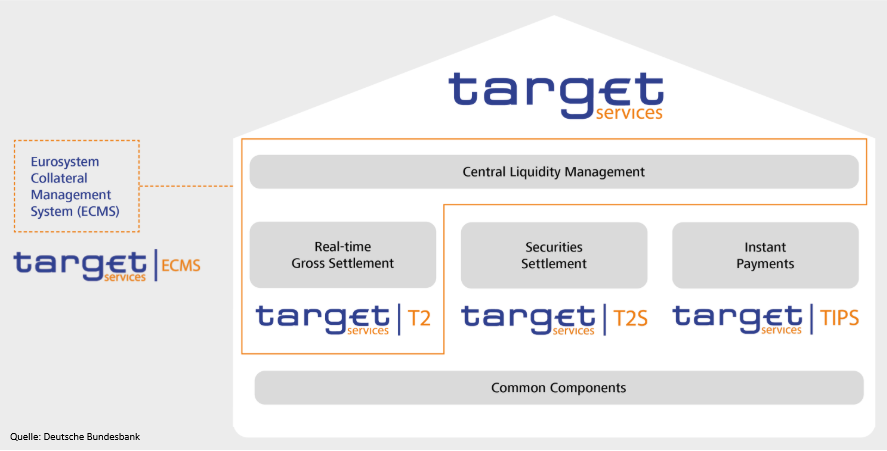
RTGS is also a component of the TARGET system. Large-value payments between participants are processed here on a final and irrevocable basis.
Gross vs. net
RTGS is best understood by looking at its counterpart: the net settlement system. Both perform the same function but with different priorities. Net settlement systems—such as the Deutsche Bundesbank’s SEPA Clearer—are designed to handle high transaction volumes. Transactions are netted against one another within a processing cycle to conserve participants’ liquidity.
With RTGS, speed is the priority.
Because the high liquidity requirement is the weakness of the procedure, modern RTGS systems have mechanisms that mitigate it without sacrificing finality:
- Queues – await payments that cannot be covered immediately, instead of being rejected
- Priorities – urgent payments are prioritized
- Scheduled payments – orders are set for a specific time
- Reservations– liquidity is held for specific purposes
- Optimization – the system searches the queue for offsetting payments and processes them together
RTGS in the Eurosystem
In the euro area, RTGS is not a standalone application but a component of T2. The latter went live in March 2023, replacing TARGET2, and consists of two parts:
- CLM (Central Liquidity Management) for liquidity management, with the MCA (Main Cash Account) as the central account
- RTGS for the processing of payments, using the RTGS DCA (Dedicated Cash Account)
In addition, depending on their participation, institutions maintain further accounts—usually a T2S DCA for securities settlement and a TIPS DCA for real-time payments.
RTGS outside the Eurosystem
Almost every major currency has its own RTGS system operated by the respective central bank—such as Fedwire in the USA, CHAPS in the United Kingdom, and SIC in Switzerland.
The common denominator is settlement in central bank money. This fundamentally distinguishes RTGS systems from private-sector clearing houses and is the reason why they are classified as systemically important infrastructure and subject to corresponding oversight.
Sources