

ECMS (Eurosystem Collateral Management System)
Published on
27/08/2026
Updated on
28/08/2026
Reading time
3 min
Definition
The ECMS (Eurosystem Collateral Management System) is the Eurosystem’s common platform for managing collateral provided by counterparties for credit operations with their central bank. It maintains records of the deposited collateral and the resulting credit positions for each institution.
The ECMS is thus the fourth TARGET service, alongside T2 (with its CLM and RTGS components), T2S for securities settlement, and TIPS for instant payments (see TARGET Services).
Es ging am 16. Juni 2025 in Betrieb.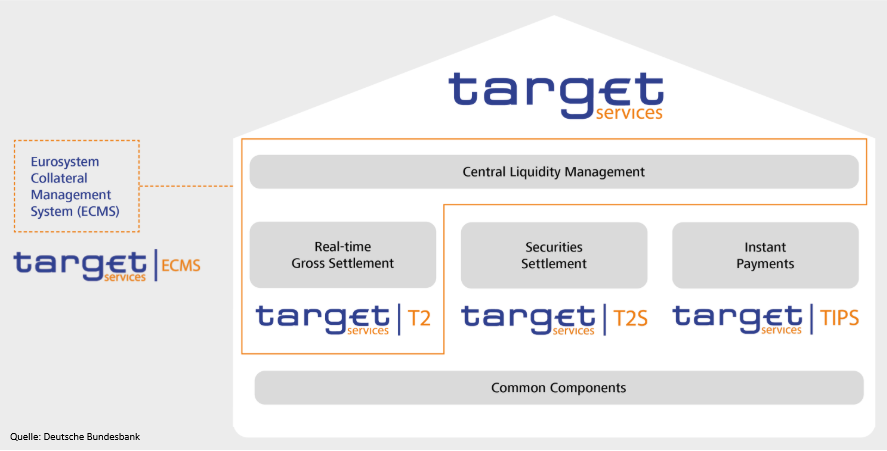
What the ECMS replaces
Until then, each of the 20 national central banks in the euro area operated its own collateral management system. An institution active in multiple countries had to deal with just as many different procedures, interfaces, and sets of rules.
The ECMS replaces these systems with a single, shared platform. In parallel, the Eurosystem has harmonized its rules for collateral management. This standardization therefore extends beyond the technical aspects to encompass the operational requirements as well.
How it works
At the core of the process is a cycle involving collateral and liquidity.
Mobilisation. The counterparty issues an instruction to pledge an asset as collateral. The ECMS converts this into a settlement instruction and initiates the transfer with the central securities depository (via T2S for securities).
Valuation and credit line. The ECMS values the collateral pool, applies haircuts, and calculates the available credit line based on these figures. It then reports this figure to CLM, the T2 liquidity module.
Usage. In CLM, the credit line is available to the institution as intraday credit—providing liquidity for RTGS payments, for TIPS, or for transactions involving ancillary systems.
In addition, the ECMS handles ongoing administration: corporate actions on pledged securities, maturities, and redemptions, as well as instructions to triparty agents who manage collateral pools on the institution’s behalf.
Who is involved
- National central banks acting as lenders and managing the business relationship
- Counterparties — i.e., institutions with access to central bank credit
- Central security depositories holding the securities
- Triparty agents managing collateral pools
Operating hours
As of 2026, the ECMS is open Monday through Friday and closed on weekends and six public holidays.
This represents a notable difference within the same family of services: while TIPS operates around the clock, 365 days a year, the ECMS follows the standard business day calendar. Anyone managing liquidity over the weekend must consider both systems in tandem—credit lines cannot be increased on a Saturday, yet real-time payments continue to be processed.
Sources
- EZB – Eurosystem Collateral Management System (ECMS)
- EZB – Eurosystem launches single collateral management system (17. June 2025)
- EZB – Launch of Eurosystem collateral management system rescheduled (September 2024)
- EZB – Introduction to ECMS (Information Pack, PDF)
- Deutsche Bundesbank – Sicherheitenverwaltung und ECMS