

An article by
Wise + AI
Published on
13/10/2026
Updated on
19/10/2026
Reading time
5 min
Why the Digital Euro Is More Than Just Digital Money
The way we pay for goods and services is changing rapidly. Contactless card payments, mobile wallets, and online shopping have become part of everyday life for millions of people. At the same time, the use of cash is steadily declining in many European countries. Against this backdrop, the Eurosystem is working on a project that could significantly shape the future of payments across Europe: the Digital Euro.
But what exactly is the Digital Euro? What opportunities could it create for consumers, businesses, and banks? And what challenges still need to be addressed?
What Is the Digital Euro?
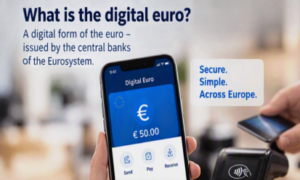
The Digital Euro would be a digital form of the euro issued directly by the central banks of the Eurosystem. It would exist alongside cash rather than replacing it.
Unlike the money held in a traditional bank account, the Digital Euro would be central bank money. This means that users would hold a direct claim on the central bank rather than on a commercial bank.
For citizens, the Digital Euro could be as easy to use as today’s digital payment methods:
- Payments in retail stores
- Online purchases
- Person-to-person transfers
- Mobile payments via smartphone or digital wallet
The goal is to provide a secure, European, and independent payment infrastructure for the digital age.
Why Is the Digital Euro Being Developed?
The European Central Bank is pursuing several strategic objectives with the Digital Euro.
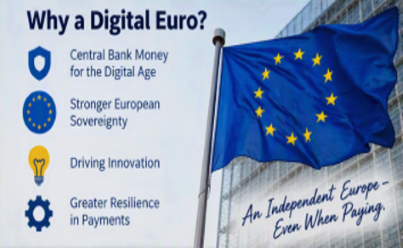
- Preserving Access to Central Bank Money in the Digital Age
While cash will continue to be available, it cannot be used for online transactions. The Digital Euro aims to ensure continued access to public money in an increasingly digital economy.
- Strengthening European Sovereignty
Today’s payment landscape is heavily influenced by international providers such as Visa, Mastercard, PayPal, and Apple Pay. The Digital Euro could help reduce Europe’s dependence on non-European payment systems and services.
- Promoting Innovation
A unified European payment platform could foster innovation in the financial sector and support the development of new business models and services.
- Increasing Resilience in the Payments Ecosystem
An additional European payment solution could enhance the stability and resilience of the financial system by providing an alternative payment channel.
What Are the Benefits of the Digital Euro?
The Digital Euro could offer a range of advantages for consumers:
- Free basic use
- High security standards
- Acceptance throughout Europe
- Instant payments
- Simple online and offline transactions
- Direct backing by the central bank
Cross-border payments within Europe could become significantly easier and more efficient.
Businesses could benefit from:
- Lower transaction costs
- Faster payment processing
- Immediate access to received funds
- Common European standards
- Reduced reliance on international card networks
Although some banks initially viewed the project with caution, it also creates new opportunities:
- Development of innovative digital wallets
- Enhanced payment services
- New value-added offerings linked to digital identity and payments
What Challenges Remain?
Despite its potential benefits, several important questions still need to be resolved.


Privacy: A Key Success Factor
One of the most frequently asked questions is whether every Digital Euro payment will be monitored.
According to current plans, the answer is no.
European central banks emphasize that privacy protection will be a core design principle of the Digital Euro. For smaller offline transactions, privacy standards similar to those of cash are being considered wherever possible.
At the same time, legal requirements related to anti-money laundering, counter-terrorism financing, and fraud prevention must also be met.
The challenge lies in finding the right balance between privacy and regulatory compliance.
Impact on Banks
If citizens were to move large amounts of money into Digital Euro holdings, commercial banks could lose deposits. For this reason, holding limits for Digital Euro accounts are being discussed.
Technical Infrastructure
Building a secure, highly available payment infrastructure across Europe requires substantial investment and rigorous cybersecurity standards.
User Adoption
The Digital Euro will only succeed if consumers and businesses perceive a clear advantage over existing payment methods.
Competition With Existing Solutions
Credit cards, instant bank transfers, and mobile payment services are already widely used. The Digital Euro must offer compelling additional value to achieve broad adoption.
Current Status
The European Central Bank remains in the project’s preparation phase. During this phase, technical concepts, legal frameworks, and market requirements are being assessed. The latest status is represented by the digital euro scheme rulebook V0.91, along with 17 annexes.
No final decision regarding the introduction of the digital euro has been made to date. An introduction could only take place following the conclusion of the testing phase and the adoption of the relevant legal framework at the European level.
Conclusion
The digital euro is one of the most important innovation projects in European payment transactions. It is intended to transfer the advantages of central bank money to the digital world and at the same time strengthen Europe’s independence in payment transactions.
For consumers, it could represent a secure, convenient payment method that can be used throughout Europe. Companies would benefit from more efficient processes, while banks could develop new digital services.
However, whether the digital euro actually becomes the new standard in European payment transactions depends on several factors: data protection, user acceptance, technological implementation and convincing added value compared to existing payment methods.
One thing is certain: the discussion about the digital euro will continue to intensively accompany the financial industry in the coming years and will have a significant impact on the future of payments in Europe.
See also:
Wie der Wasserfall Mechanismus beim digitalen Euro funktioniert
Share