

Published on
06/07/2026
Updated on
10/07/2026
Reading time
2 min
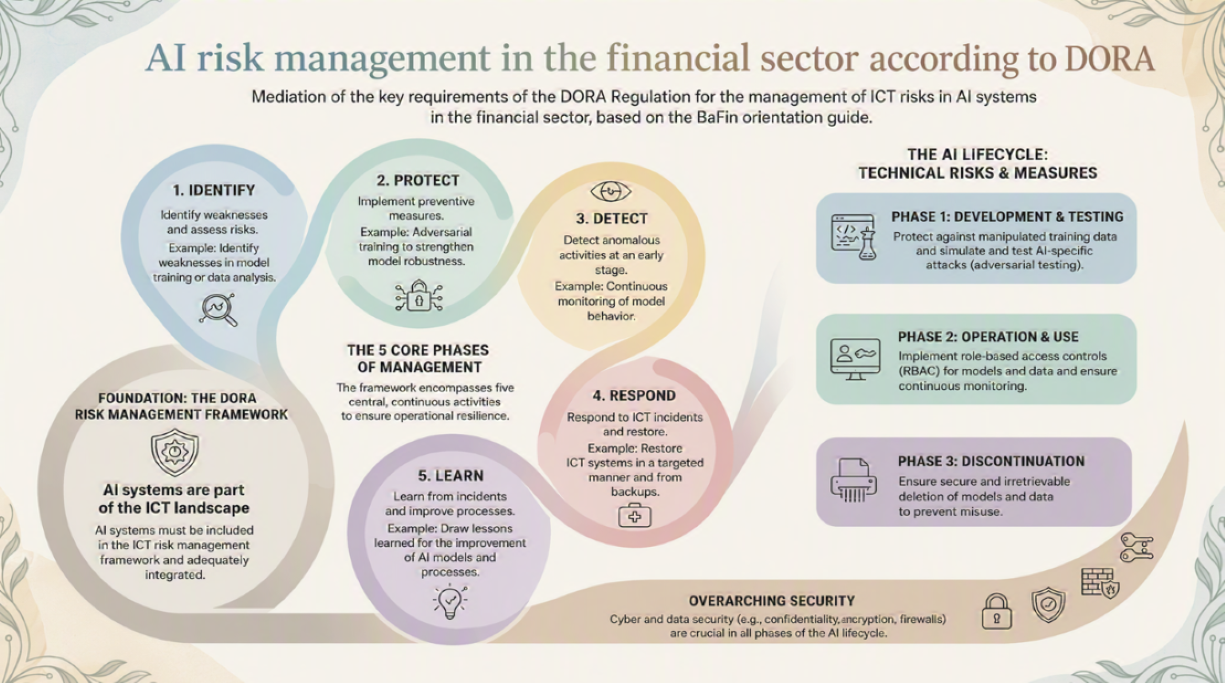
On December 18, 2025, the Federal Financial Supervisory Authority (BaFin) published a guidance document for regulated financial companies, meant to provide support for using Artificial Intelligence (AI). The document isn’t mandatory but is supposed to make the regulatory requirements for using AI more understandable in light of the Digital Operational Resilience Act (DORA). This article gives an overview of BaFin’s AI guidance.
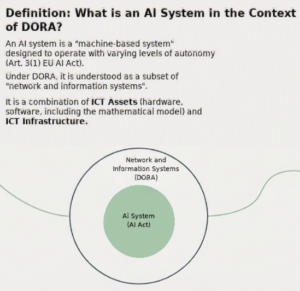
How does the EU AI regulation define the term ‘AI system’?
According to Art. 3 No. 1 of the EU AI Regulation, an AI system is a “machine-based system designed for varying degrees of autonomous operation, which can be adaptable after it starts operating, and which derives from the inputs it receives how outputs such as predictions, content, recommendations, or decisions are created for explicit or implicit goals that can affect physical or virtual environments.”
The EU AI Regulation, like DORA, is the overarching framework within which BaFin fulfills its supervisory duties.
Programming with AI Tools
Programming with AI tools is explicitly mentioned in BaFin’s AI guidance. The ‘Code generation with AI assistants’ even gets its own section and makes it clear that the regulatory requirements apply no matter who wrote the code. Anyone developing software with AI needs to have the proper knowledge and skills to evaluate and test the results. For example, it has to be checked to what extent the generated code calls external, AI-based functions (like through APIs) without it being intended.
Conclusion for financial companies
Source: KI Orientierung BaFin
Share