The EU has a reputation for frequently requesting data from companies for statistical purposes. In the case of banks and financial services providers in Germany, for example, payment transaction data is collected via the Bundesbank for statistical purposes (see
banking statistics).
A number of sectors are currently being revised
- BSI (Balance Sheet Statistics of Monetary Financial Institutions)
- MIR (MFI Interest Rate Statistics)
- SHS-S (Statistics on Securities Holdings – Sector Module)
- AnaCredit (Analytical Credit Data)
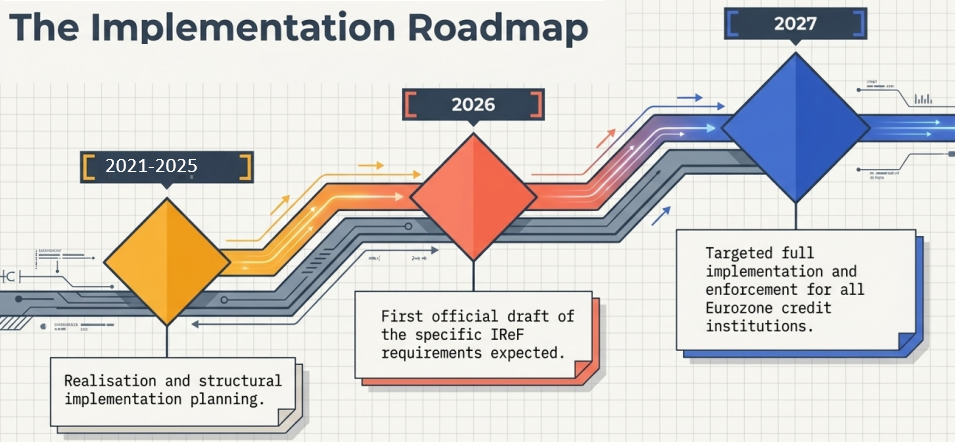
It is precisely these reporting requirements that will be subject to new regulations in 2027.
Integrated Reporting Framework (IReF)
The ECB’s future IReF is intended to fundamentally harmonise the statistical reporting requirements for financial institutions in the Euro area. The aim is to reduce the heavy reporting burden and the fragmentation caused by heterogeneous national reporting systems. The IReF replaces the existing requirements for Balance Sheet Items (BSI), MFI Interest Rates (MIR), Securities Holdings Statistics (SHS) and the AnaCredit credit register. It marks a paradigm shift from traditional, aggregated templates (template-based reporting) towards the provision of granular transaction-level data (data-based reporting), in line with the principle of ‘collect once, use many times´.
Data Modelling and Normalisation
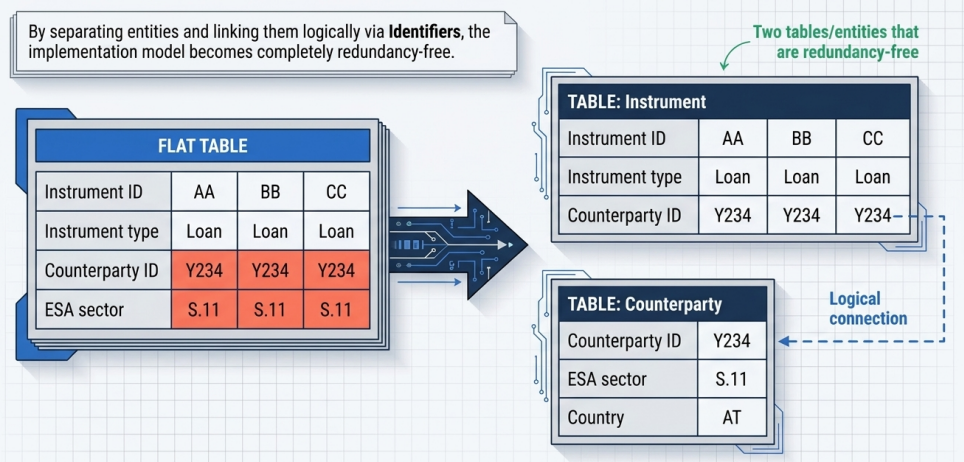
A key methodological aspect of the IReF data model is normalisation. As illustrated by the specified database schemas, a flat table containing redundancies – in which debtor master data such as the ESA sector or the country are repeated for each loan – is systematically split into two separate, normalised tables:
- An instrument table for recording granular loan and securities data.
- A counterparty table for storing unique identifiers and master data for market participants.
This structure eliminates storage redundancies and improves data consistency. In addition, a separate event table records transaction events and cash flows, such as coupons or share splits, directly at source.
Integration of country-specific requirements (CSRs)
 Despite standardisation, country-specific requirements (CSRs) remain, for example in relation to national credit registers. The Extended Technical Layer (ExTL) concept provides for two integration scenarios in this regard:
Scenario 1 (Complementary reports): National central banks collect additional country-specific variables separately via complementary reporting channels.
Scenario 2 (Extended Common Layer): Optional national requirements (e.g. narrower maturity bands) are integrated directly into the harmonised technical data model. Banks can, by default, provide more data in order to centralise reporting processes for foreign branches and subsidiaries across the group.
The data ecosystem: BIRD, JBRC and the DPM Alliance
The optional, open-source translation tool BIRD (Banks’ Integrated Reporting Dictionary) supports institutions with data extraction. It transfers the raw data in stages from the Logical Data Model (LDM) and the Input Layer (IL) into the IReF format (Reference Output Layer, ROL), which is ready for reporting. Semantic harmonisation and the definition of standardised terms are overseen by the Joint Bank Reporting Committee (JBRC), established in March 2024. This is supported technically by the EBA-ECB-EIOPA Data Point Model (DPM) Alliance, which ensures the interoperability of the dictionaries using the DPM 2.1 metadata model.
Technological Transformation and Data Quality
The immense flood of granular data requires the modernisation of IT infrastructures. To this end, the Eurosystem relies on the resource-efficient
XBRL-CSV transmission format, which compresses data volumes to less than 10 per cent of those of traditional XML formats. Data quality management (DQM) must be fully automated and moved to the start of the process chain; manual correction at a later stage is technically impossible under IReF.
If you have any questions about IReF or require technical support, please do not hesitate to
contact us.