

Published on
08/06/2026
Updated on
09/06/2026
Reading time
3 min
The first SEPA Request-To-Pay Scheme Rulebook was published in November 2020 and was then regularly revised.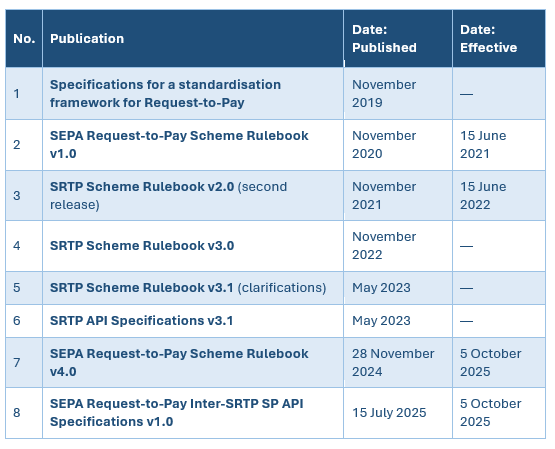
On May 13, a clarification paper was published with the purpose of serving as a guide of the European Payments Council (EPC) to ensure a uniform and fragmentation-free implementation of the SRTP Rulebook v4.0.
Essential contents of the SRTP Clarification
The document contains detailed clarifications on the following specific subject areas of the SEPA Request-to-Pay Rulebook:
- Time models for acceptance and payment: (“Accept now/later & Pay now/later”): How to handle deadlines for accepting the payment request and for the actual initiation of payment
- Payer options: The conditions under which a payer (if authorized by the payee) can choose a different payment amount or another payment date.
- Payment guarantees: Dealing with requests for payment guarantees (‘Request for payment guarantee’), whereby the actual guarantee contract always lies outside the SRTP system.
- URLs and redirects: The handling of attached web links in the message as well as of ‘Return to merchant URLs’, which automatically redirect the buyer back to the merchant’s website after the transaction.
- Cancellation and status inquiries: The applicable deadlines for cancellations (‘Request for Cancellation’) or status updates. These can generally only be sent until the expiration date (Expiry Date/Time) of the respective SRTP message.
- Alternative scheme models: The applicability of the regulations to alternative, simplified architectures such as, for example, the 3-corner model.
- Unknown SRTP addresses: Additional steps and redirect scenarios (redirects) in e-commerce or at the point of sale (POS) that come into play when the merchant does not know the exact SRTP address of the payer in advance.

- Currency independence (“Currency agnosticism”): SRTP messages can be issued in any official SEPA currency, but each individual message is always limited to exactly one currency.
- Fees and purpose of use: The use of the optional data placeholder for fees (AT-S013) and the correct inclusion of structured or unstructured remittance information to facilitate payment allocation.
- Enrolment and Activation (Registration & Activation): Detailed explanations, illustrations, and implementation guidelines for ISO 20022 messages (REDA) regarding mandatory registration with the respective service provider and mutual activation between sender and receiver.
- Installment payments and credits: The precise handling of instalment payment requests (‘Instalment payments’) as well as the possibility of processing credits via an SRTP message with the set payment amount of zero.
- Payment initiation status: The optional function for querying the current status of a payment initiation.
- EPC Directory Service (EDS): Details on the mandatory joining process (adherence process), the compulsory EDS registration, and the ongoing maintenance of operational and contact data, such as API endpoints and security certificate data.
- SRTP System Options: An overview of the selectable scheme options (e.g., attachments, installment payments, redirect), which support the participants and can be stored centrally in the EDS for visibility by others.
- Homologation process (approval procedure): Specific explanations of the different types of approvals for scheme applicants and technical solution providers.
Even a fleeting glance at the SRTP Clarification is enough to grasp the complexity of implementation for the account-holding banks. If you, as a financial institution, have questions about the SRTP Clarification, we look forward to your contact.
Share
Weitere Artikel